Is changing the clock a waste of time?

large

C1 – Advanced

Daylight Saving Time is the practice of advancing standard time by one hour in the spring of each year and of setting it back by one hour in the fall in order to gain an extra period of daylight during the early evening. Many countries observe this change.

Let’s try to know more about its history and significance. Watch the videos and listen to the audio clips with the transcript.

What is daylight saving time?

Every year billions of us around the world observe the familiar ritual of winding our clocks forward in the spring and turning them back again in the autumn.

To the joy of some and the annoyance of others, this biannual time-tampering first steals 60 minutes of our sleep, then gives us all an ‘extra’ hour in bed. Of course, in reality we are neither losing nor gaining time. By shifting an hour of sunlight during the summer months we’re merely making better use of the daylight temporarily available to us in the evenings.

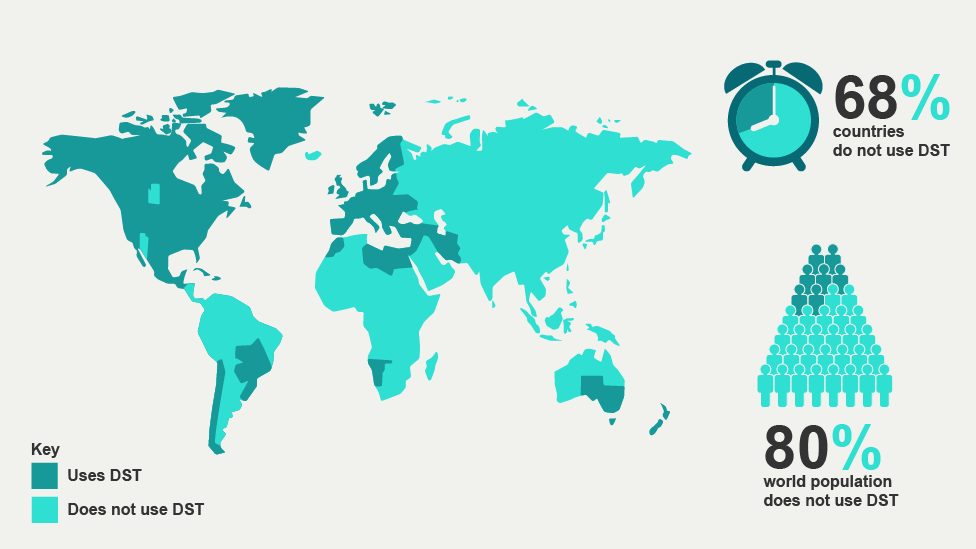
There are many countries worldwide that do not observe daylight saving time (DST) – and in those that do it has had a somewhat chequered and quirky history. Are those of us who meddle with our clocks making time or killing time?

In the UK we observe Greenwich Mean Time (GMT) in the winter months, and advance an hour during British Summer Time (BST). From time to time Parliament has debated the idea of adopting BST throughout the year, but a permanent change is yet to happen.

A permanent change

The case in favour

Those in favour of year-long BST say it would benefit our health and well-being. A 2014 study of 23,000 children in nine countries suggested their activity levels were 15-20% higher on summer days. The Automobile Association estimates that around 100 lives each year would be saved by avoiding traffic accidents on dark evenings.

Year-round BST would also bring the UK into line with Central European Time, helping us to do business with the continent. In the view of the British Association of Leisure Parks, Piers and Attractions this would increase domestic tourism earnings by £2.5-3.5bn.

Meanwhile, an extra hour of evening sunlight in winter could save £485m a year in electricity bills, as households would require less energy to heat and light their homes.

The argument against

Those against a permanent change to BST say it would delay sunrise in northern Scotland until 10am in the winter months. This would leave children at increased risk of accident walking to school in the dark.

Farmers, postal workers and the construction industry have also traditionally supported lighter mornings.

Some say that even if we did move onto BST all year round, we may still end up changing the clocks twice a year. Proposals have been made to adopt GMT+1 during the winter and introduce GMT+2 in summer.

Discuss:

1. What is the resource saying about Daylight Savings Time?
2. Do you see a drawback to having to adjust your clocks on specific seasons?
3. Do you, personally, think that adjusting is a waste of time? Or is this needed?
4. What is the longest night time you have experienced?


Children Spend Six Hours on Screens

_81934166_babieswithtabletsC1 – Advanced

Although TV viewing has dropped, the dramatic increase of children glued to a screen has been observed. They are even using multiple screens. This phenomenon can be accounted for the availability of different media.

Read the article below to know more about the facts regarding children and their screen time.

Children spend six hours or more a day on screens

Discuss:

1. What are the popular tools being utilized by children these days?
2. Do these media post greater threat than good?
3. In your country, how are kids now different from kids then?
4. Do you have any rules for your children when using gadgets?


Building Self Confidence

163x150xconfidentwoman.jpg.pagespeed.ic.ADbofbfO12

B2 – Upper intermediate

Confidence is knowing and implying what you’re good at, your value to other people, and acting in a way that shows that to others. Our level of self-confidence can convey in many ways: our behavior, body language, how we speak, and what we say.

Read the article below to know more on how we can be confident in ourselves.

How to Build Self-Confidence

Discuss:

1. Do you agree with what the article says about being more self-confident?
2. How do you confront your fears?
3. What do you do to make sure you’re taking good care of yourself?
4. Do you believe in pep talk?


The Widening Aisle Of Interracial Marriages

B2 – Upper Intermediate

Multicultural marriages have been more popular than ever. Many reasons have been attributed in seeking partners from another country.

Let’s know more about real people’s accounts. How are they managing their relationship?

http://www.npr.org/sections/codeswitch/2014/02/13/276516736/walking-down-the-widening-aisle-of-interracial-marriages

Discussion Questions:

1. How are interracial and multicultural marriages viewed in your country?
2. Do you have friends or know anyone who married someone of a different race or culture?
3. In your opinion, what are some of the challenges that couples of mixed marriages face?

Yotel – Tiny Hotel Rooms

B2 – Upper Intermediate

Whether you are on a vacation or on a business trip, one of the things that is on the top of your list is a nice play to stay at where you can relax after a long day of city tour and shopping or after an intense meeting with a client.

A new hotel has just opened in the city of New York in the U.S. Find out below what makes it different from the rest.

http://www.english-online.at/news-articles/travel/yotel-tiny-hotel-rooms-in-manhattan.htm

Discussion Questions:

  1. Do you like staying at hotels when travelling?
  2. Have you experienced staying at a luxurious hotel?
  3. What are some of the excellent accomodations that you’ve stayed at in the past?
  4. Are there unique places to stay in in your city?

A Personal Air Vehicle

B2 – Upper Intermediate

The future is now. That is, if we go by the timeline set by the iconic sci-fi movie “Back to the Future.” So where are all the flying cars? According to Professor Missy Cummings in this BBC feature, there are only a few hurdles to the development of personal air vehicles. And technology is not one of them.

Watch the video then read the article and be ready to express your thoughts about the topic.


The idea of having a part car, part plane, part drone parked outside your home may not be as far-fetched as it seems. There really aren’t any technological hurdles to this.
W

We are going to have personal air vehicles that are both cars and planes, at least that’s Missy Cummings’s vision of the future. It’s basically the intersection of a drone with a robotic car, so that your plane is also your car, but the big leap in technology is that you are actually driving neither, says the Associate Professor of Aeronautics and Astronautics at the Massachusetts Institute of Technology.

Drones have a negative bias in the media, says Cummings, because they are essentially seen as spy cameras. But most people don’t realise that when they are on a plane they are effectively travelling on a drone. The fly-by-wire technology that exists on all Airbus and many Boeing craft is the exact same technology that exists on drones.

The reason why drones are the answer to the future is that the truth is we are terrible drivers. Humans inherently have a half-second lag in almost any quick response that they need to have, like a ball rolling out in a street or seeing an aircraft in the sky and you have to take evasive action. Even a half-second delay can mean the difference between life and death, and computers and automated systems don’t have that – they have microseconds.

So, our transportation network of the future, both on the ground and in the air, will actually be safer when we turn it over to computers.

There really aren’t any technological hurdles to this idea, says Cummings. The biggest hurdles we have are psychological and cultural, in terms of giving up the car. But no new tech needs to be developed to have your own personal flying car. What we have to do is improve production and reduce manufacturing costs, and what that means is that we need more robots. So this is almost a self-circular process, where we need robots to build robots to make them cheaper.

Should we worry about the machines rising up and taking over? No, what Cummings says she is worried about is hackers and terrorists who want to do wrong. One of the things she is working on is trying to develop technology that allows any flying robot to be able to fend off any attack and be able to navigate itself without any GPS or any other external signal.

There are lots of different possibilities for what your personal air vehicle could look like. You could own your own in your driveway or garage, and you could jump in it. Or we could have a shared network like the plane version of Zipcar. People should be excited about this: it promises much in terms of safer travel, and in parts of the world where the road and air networks are poor, people will be able to get the goods and services they need.

So, when we look at globalising this concept of personal air vehicles, it means we will see the quality of life improve dramatically for everyone around the world

Discussion Questions:

1. Would owning a personal air vehicle simplify or complicate our lives?
2. What are the hurdles that prevent the full realization of the flying car?
3. If personal air vehicles will essentially be robots, what can be done to ensure that they will be hacker-proof?

No Dislike Button for Facebook

7d099812-63f1-4bab-85ad-f40cc476fdf4-620x372

B2 – Upper intermediate

If you’re a Facebook user, you’ve probably noticed that there’s more than one reaction button to choose from. You’ve got the simple “like” button, then you’ve also got the “wow” and “sad” buttons.

Read the article below to get more information as to why Facebook decided to come up with more reaction buttons.

No dislike button for Facebook, declares Zuckerberg

Discuss:

1. Do you approve of Facebook’s decision to not add a “dislike” button? Why or why not?
2. How do you generally feel about Facebook?
3. What other social media websites do you use?
4. How is social media useful in today’s society?

* As of September 2015, Facebook has announced that it is working on the “dislike” button. Watch the video here

Building a ‘Halal’ Internet

B2 – Upper Intermediate

Officials in Iran are planning to build a completely separate Internet called Yooz. Its purpose is to filter objectionable information just like China’s “Great Firewall”, the largest web filtering and censorship operation in the world.

Read the article below to know more about Yooz then express your opinions.

http://learningenglish.voanews.com/a/iran-next-step-in-building-hala-internet/2676579.html

Discussion Questions:

  1. How often do you use the internet?
  2. How important is the internet to your day to day life?
  3. What is your opinion about filtered and censored internet access
  4. Do you think that Yooz will do its job in filtering and securing?

The Family That Eats Together

2002fall_the-family-that-eats-together_640x360

B2 – Upper intermediate

Family dinner builds good and positive relationship among the members. It also helps kids do better in school. But because of hectic schedules many families seldom have the time to do this anymore.

Read the article below to discover the benefits of dining together.

https://www.vision.org/family-eats-together-1336

Discussion Questions:

1. Do you agree with what the article is saying about family dinners?
2. Is this something that is usually practiced in homes in your country?
3. Does your country have very strong familial relationships?

Bizarre Foods Around the World

B1 – Intermediate

When travelling, it is usual for other people to try the country’s popular dish. But sometimes we need to be adventurous to try some of the local food.

Let’s find out some of the strangest food around the world. You may read the article.. Watch the video also at the end of the article.

Have you ever heard the proverb one man’s meat is another man’s poison? It is a proverb that means something one person likes very much can be something that another person does not like at all. Here are five foods that might seem bizarre to some people, but delicious to others. Are they your meat or your poison?

Haggis

This is a Scottish dish that contains the internal organs of a sheep. It includes the liver, the heart, and the lungs. This is mixed with onions, raw fat, salt, and spices.

A Fried Brain Sandwich

A fried-brain sandwich is a sandwich made with sliced calves’ brains. It became a popular dish in St. Louis, Missouri, USA in the late 1880s.

Fugu

Fugu is a Japanese poisonous puffer fish. If you eat the poison of this fish, it can kill you. Only specially-trained chefs can prepare this fish because it is so dangerous.

Fried Spider

Fried spider is a delicacy in some parts of Cambodia. The spiders are fried and usually only the legs are eaten.

Sannakji

Sannakji is a Korean dish. It is made with live nakji (small octopuses) that have been cut into small pieces. They are usually still moving on the plate when this dish is served. They are usually seasoned with sesame and sesame oil.

Discuss Questions:

1. What delicacies have you tried?

2. What delicacies do you want to try and those that you never want to?

3. Have you tried strange food before?